12 Best Nancy Meyers Dining Room Ideas That Bring Classic Movie Charm Home With Timeless Style
Warm white walls, a table that begs people to stay, linen that is allowed to crease, and flowers that look just-cut. Here is how to borrow the most loved dining rooms in the movies — and make the look work in a real home, on a real budget.
Why These Rooms Linger
Nobody Remembers the Plot Twist. Everybody Remembers the Dining Room.
Think of the dinners in It’s Complicated, Something’s Gotta Give, The Holiday and Father of the Bride. The food is simple, the wine keeps coming, and nobody is in a hurry to leave the table. That feeling is not an accident of set design. It is built, layer by layer, from choices any home can copy: light first, comfort always, and nothing so precious it cannot be used.
That is the encouraging news in this article. The Nancy Meyers look is not a luxury look. Its ingredients — warm white paint, one honest wood table, washable linen, woven texture, good lighting on a dimmer, fresh flowers — are mostly inexpensive, widely available second-hand, and forgiving of imperfection. In fact, imperfection is part of the specification.
How to use these 12 ideas: Work in order if you are starting from scratch: ideas 1-4 set the bones (colour, table, seating, fabric), 5-7 add the architecture and glow, and 8-12 are the layers you can add in an afternoon. Renters can do almost everything here except the built-ins — and idea 5 includes the freestanding version. Each idea ends with the one mistake that most often undoes it.
1. Start With Sun-Washed Whites, Never Stark Whites
Warm white is the foundation of every Nancy Meyers dining room you remember — the beach house in Something’s Gotta Give, the sunlit rooms in It’s Complicated. It is never hospital white. It is white with warmth in it: cream, ivory, linen-white, with wood and woven texture laid over the top so the room glows instead of glaring.
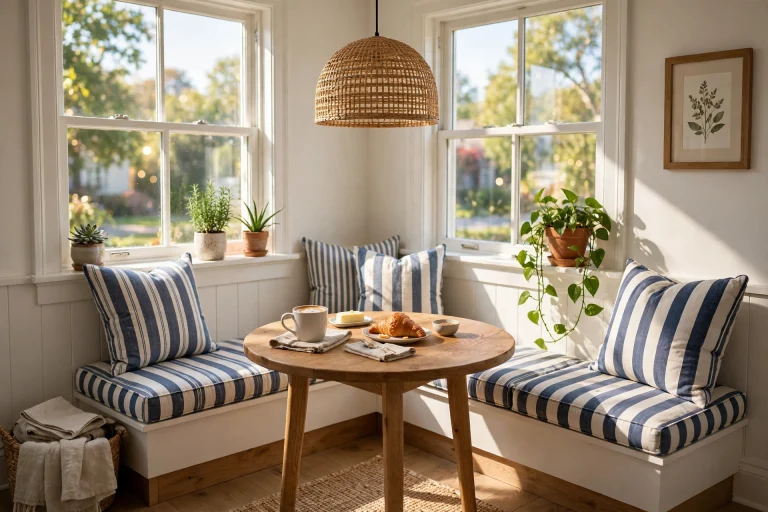
Choose a warm white for walls and trim, then repeat it in upholstery and curtains so the light bounces softly around the room. Keep ceilings the same colour for that calm, cocooning feel, and let the floor — honey oak, walnut or a faded rug — supply the contrast.
Get the look: Pick warm whites with yellow or grey undertones, and test them at morning and evening light. Use sheer linen curtains, not blackout drapes, so daylight stays in the room all day. Add one darker note — a walnut frame, black door hardware — so the white has something to lean against.
Watch out: Pure brilliant white under cool LED bulbs turns this look clinical. Warm bulbs (2700K) keep it golden.
2. Choose One Generous Harvest Table and Let It Be the Hero
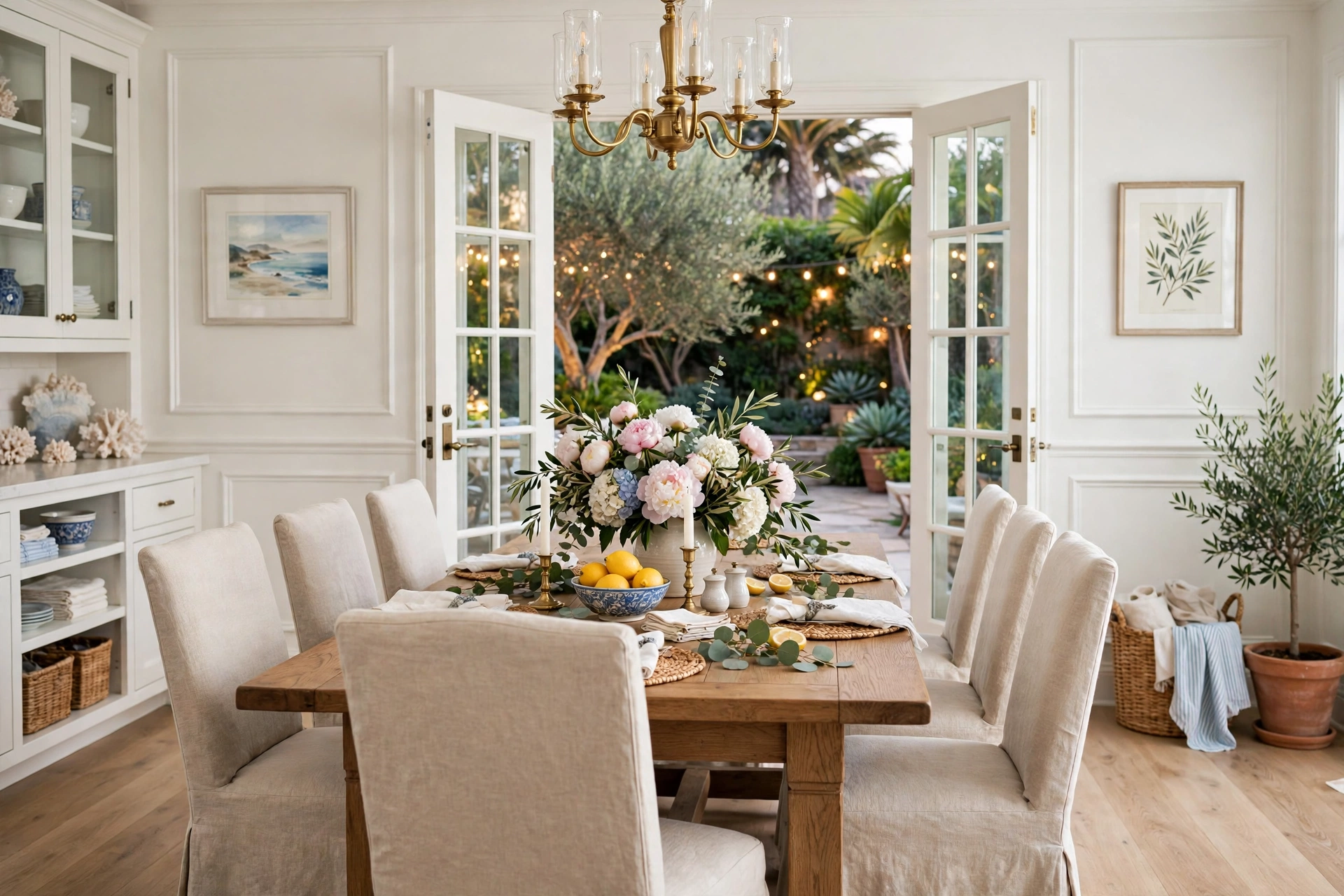
In a Meyers film, the table is never squeezed into a corner. It is long, solid and unapologetically central — a place for Sunday lunch, homework, flower-arranging and a dinner that runs three courses too long. Size and honesty of material matter more than ornament.
Look for a thick top you can see the grain in, sturdy legs, and room for two extra chairs you did not plan for. A few marks are welcome here. A table that shows a life being lived is the whole point; a perfect, precious one works against you every time guests reach for a hot dish.
Get the look: Aim for at least 90 cm width so platters can live in the middle while people eat. Seats six comfortably means seats eight happily — buy for the gathering, not the everyday. Skip the matching set: a characterful second-hand table beats a showroom suite.
Watch out: Measure your doorway before you fall in love. Harvest tables are famously wider than modern doors.
3. Mix the Seating: Slipcovered Hosts, Honest Wooden Sides
Nothing in these rooms matches perfectly, and the seating proves it. Upholstered or slipcovered chairs anchor the ends of the table, while simpler wooden or woven chairs line the sides. The mix says: some of this was chosen, some of it was inherited, all of it is comfortable.
Slipcovers are the practical genius of the look. They read as tailored and relaxed at once, and they go in the wash after red wine happens — which, in a room designed for long dinners, it will. Keep the palette tight (white, natural linen, soft stripe) and let the shapes do the mixing.
Get the look: Put the two most comfortable, upholstered chairs at the heads of the table. Repeat one material — rush, cane or oak — across the side chairs to hold the mix together. Choose washable slipcovers in a slightly rumpled linen or cotton twill.
Watch out: Comfort is non-negotiable. If a chair is only good for twenty minutes, it does not belong here, however pretty it is.
4. Layer Linen Everywhere — and Let It Stay Softly Rumpled
Linen is the fabric of this world: tablecloths, runners, napkins, curtains and chair covers, all in natural, oat, white and the palest stripes. It softens hard wood, absorbs sound so conversation feels intimate, and — crucially — it looks better slightly creased than pressed flat.
Start with one good cloth or a long runner, then add napkins you will actually use daily, not save for guests. Mix weights if you like: a heavier cloth, gauzier curtains. The effect should feel gathered over years, so buy slowly and let charity shops and sales do some of the work.
Get the look: One full linen cloth in natural or white transforms even a plain table instantly. Cloth napkins, every day — they are cheaper over time and make Tuesday feel like an occasion. Wash cold, line-dry, and skip the iron except for the top fold.
Watch out: Do not buy a full matching linen set in one go. Identical everything is exactly what this style avoids.
5. Build In Storage That Shows the Good Dishes
Meyers dining rooms always seem to have somewhere beautiful for things to live: a glass-front hutch, a wall of built-ins, shelves of white china waiting for their moment. Display here is not showing off — it is keeping the things you love in sight and in use.
If built-ins are out of budget, a single freestanding hutch or open shelves give the same effect. Paint the inside of a cabinet a deep colour — navy, ink or forest — and plain white dishes will sing against it. Group by type, leave breathing room, and keep everyday pieces on the lowest, easiest shelves.
Get the look: Display white and cream china together; the subtle shade differences are the charm. Hide the clutter below: closed cupboards for placemats, candles and serving boards. Add brass or black hardware for that quiet, classic contrast.
Watch out: Edit ruthlessly. A cabinet stuffed to the glass reads as storage, not display — keep a third of each shelf empty.
6. Hang Lighting That Glows Like Candlelight
Over every memorable table hangs a light worth looking at: a lantern, a beaded chandelier, a pair of pendants, always warm and always on a dimmer. Lighting in these rooms is jewellery and atmosphere in one — it should flatter faces first and furniture second.
Scale is where most rooms go wrong. A fixture about half to two-thirds the width of your table, hung low enough to feel intimate (roughly 75-90 cm above the tabletop), creates the pool of light everyone leans into. Add wall sconces or a lamp on the sideboard so the pendant is not working alone.
Get the look: Put every dining light on a dimmer — this single change does more than any fixture. Choose warm bulbs and shades that diffuse, never bare bulbs at eye level. Two smaller pendants over a long table often beat one large one.
Watch out: A chandelier hung at ceiling-hugging height kills the intimacy. Lower it, then lower it a little more.
7. Style the Sideboard Like a Still Life
Against one wall, almost without fail, sits a sideboard doing quiet double duty: storage inside, a small composed scene on top. A lamp, a stack of books, a bowl of fruit, something green. It gives the room a second focal point and gives dinner parties a place for drinks, desserts and extra plates.
Compose it in threes and at different heights: something tall (lamp or branches), something mid-height (art or a mirror leaning, not hung), something low and useful (a tray, a bowl of lemons). Then stop. The Meyers touch is abundance with air around it, never a surface covered end to end.
Get the look: A pair of matching lamps either end is the most classic, symmetrical version. Lean a mirror or framed print behind the arrangement to catch the light. Keep one clear landing zone — serving food is this furniture’s day job.
Watch out: If you have no sideboard, a console, dresser or even a sturdy bookshelf at the right height works just as well.
8. Bring Flowers In Like You Just Cut Them
No Meyers table is complete without something living on it: hydrangeas in a jug, roses in a low bowl, branches in a tall vase, a bowl of green apples when flowers are not in season. The arrangements are generous and loose — gathered, never sculpted.
Keep one wide, low vessel you love and fill it with whatever is cheap and plentiful that week: supermarket roses opened up, garden clippings, eucalyptus, even herbs. Keep arrangements below eye level so guests can talk across them, and cluster candles around the base for evening. When nothing is blooming, a bowl of lemons or oranges does the same job in colour.
Get the look: Buy flowers in one colour and let quantity, not variety, make the impact. Cut stems at different lengths so the arrangement looks hand-gathered. Retire arrangements early — fresh and simple beats grand and wilting.
Watch out: Tall, tight, florist-perfect centrepieces belong to hotels. Loosen it, lower it, and add one stem that leans the wrong way.
9. Weave in Texture: Rattan, Cane, Seagrass and Jute
White rooms need texture the way food needs salt. Woven chair seats, a jute or seagrass rug under the table, rattan pendants, woven placemats and baskets bring the coastal, collected warmth that stops all that white and wood from feeling flat.
Layer at least three woven textures at different scales: a large one underfoot, a medium one in the seating or lighting, and small ones on the table. Natural fibres also hide a multitude of sins — crumbs, scuffs and fading all blend in — which is precisely why they suit rooms built for real life.
Get the look: A natural-fibre rug should extend at least 60 cm beyond the table on all sides so chairs stay on it. Mix weave scales: chunky jute below, fine cane above. Baskets corral napkins, bread and clutter while adding instant texture.
Watch out: One woven item looks like an accident. Three, at different scales, look like a decision.
10. Add Blue-and-White — the Pattern That Never Dates
If one pattern owns this style, it is blue-and-white: willow-pattern plates, chinoiserie ginger jars, striped cushions, a lamp base turned into a vase. It is the classic contrast to all that warm white and wood, and it has looked right for about three hundred years.
You do not need a full set. Start with one ginger jar as a vase, a stack of mismatched blue-and-white plates from a charity shop, or napkins in a deep indigo. Blue-and-white mixes happily with itself across patterns and centuries, so collecting it slowly is not just allowed — it is the traditional way to do it.
Get the look: Use blue-and-white for the table first: plates, a runner or a jar of white flowers. Pair it with warm wood and brass so it reads classic, not cold. White flowers in a blue-and-white jar is the single most Meyers centrepiece there is.
Watch out: Keep the blue deep and inky rather than pastel. Soft baby blue tips the room from timeless toward nursery.
11. Open the Room to the Garden With French Doors
So many of these scenes end the same way: doors thrown open, a terrace beyond, dinner drifting outside for coffee. The connection to green — French doors, a wall of windows, even one big window over a garden — is part of the architecture of the charm.
You may not be able to add doors, but you can borrow the effect. Keep window treatments sheer and pulled wide, place a tall plant or small tree just inside the glass, and position the table so diners face the view rather than a wall. A mirror opposite the window doubles whatever green and light you have.
Get the look: Dress windows from ceiling to floor in sheer linen to maximise light and height. Put the garden in the sightline: table facing the window, not backed against it. Carry one colour from the garden inside — leaf green cushions or a potted olive tree.
Watch out: Heavy drapes and closed blinds undo this idea completely. If privacy demands cover, choose sheers plus a simple blind you open fully by day.
12. Finish With Books, Art and Beautifully Lived-In Layers
The final layer is the one that cannot be bought in a single trip: books stacked on the sideboard, a framed print that means something, a bowl that came from a trip, photographs, a throw over one chair. Meyers rooms feel loved because the people in them clearly live there.
Add these layers last and add them slowly. Leave a shelf for the stack of cookbooks you actually open, hang art you chose rather than art that matched, and keep one or two imperfect, personal things in view. Then resist finishing the room. In this style, a room that can still absorb a new find is a room that is working.
Get the look: Stack books horizontally as risers for lamps, vases and candles. Choose one large piece of art or a mirror rather than a scatter of small frames. Rotate layers seasonally: shells in summer, branches and candles in winter.
Watch out: Perfection is the enemy here. If every object arrived the same week, the room will read as a set — charming, but not yet home.
Putting It Together — Choose Your Starting Point, Then Give It One Weekend
If your room feels cold or stark, start with ideas 1, 6 and 9: warm white, dimmed warm light and woven texture fix temperature fastest. If it feels formal and unused, start with ideas 3, 4 and 8: slipcovers, everyday linen and loose flowers lower the stakes instantly. If it is small or rented, start with ideas 2, 5 and 11: a right-sized table, a freestanding hutch and sheer curtains need no building work. If it is fine but flat, start with ideas 7, 10 and 12: a styled sideboard, blue-and-white and personal layers add the missing story. Starting from empty, work through ideas 1-4 in order: colour, table, seating and fabric are the bones everything else hangs on.
A one-weekend plan: Saturday morning — clear the room completely, clean the windows, and hang sheer linen curtains as high and wide as they will go. Saturday afternoon — centre the table on the rug (or add the jute rug), lower the pendant, and fit dimmers and warm bulbs. Sunday morning — dress the table: runner or cloth, your best everyday plates, cloth napkins, one low bowl of flowers or fruit. Sunday afternoon — style the sideboard in threes, stack the cookbooks, lean the mirror — then cook something simple and eat in there.
The real test of a Nancy Meyers dining room is not how it photographs. It is whether people drift toward it with a morning coffee, whether homework and laptops give way to dinner without a fuss, and whether guests are still at the table long after dessert. Build for that — warm, comfortable, a little rumpled, ready for one more course — and the movie charm takes care of itself.
Film titles are mentioned for reference; this article is not affiliated with Nancy Meyers or the studios behind the films.